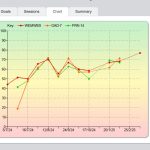
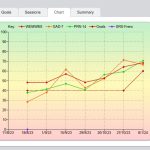
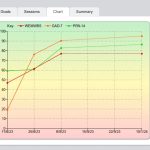
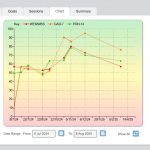
The anonymised charts shown here reflect something I notice again and again in my work with clients.
Over time, as anxiety begins to reduce, wellbeing often starts to improve too. Using routine outcome measures, here GAD-7 (anxiety) and WEMWBS (wellbeing) a consistent pattern emerges across different people, each with their own unique story.
In many cases, these changes also seem to sit alongside a shift in how core emotional needs are experienced. These could be such as feeling safer, more connected, more understood, and more able to respond to life with flexibility rather than overwhelm.
This leads to an important question:
Which comes first: a reduction in anxiety, or the meeting of emotional needs?
Does anxiety begin to ease because something deeper is changing? because a person is starting to feel more secure, more supported, or more aligned with themselves?
Or does a reduction in anxiety create enough space for those deeper needs to come into awareness and begin to be met?
In reality, it often seems to be a gentle, ongoing interaction between the two. As anxiety settles, people can think more clearly, feel more steadily, and engage more fully in the therapeutic process. And as emotional needs are met more consistently, anxiety often softens in response.
Rather than a single cause, what the data suggests is a process, and one in which change builds gradually, layer by layer.
The charts here are not intended to offer simple answers, but to share something of how change can unfold in real therapeutic work. So, what does this mean for me?
All data is fully anonymised and shared only to illustrate patterns that may be helpful in understanding the therapeutic process.